Showing posts with label Rick Sammon. Show all posts

Saturday, August 18, 2012

Digital Photo Experience Interview with Hal

Rick Sammon in "The Suit"


Hal on the Digital Photo Experience with Rick Sammon and Juan Pons

Check out the new podcast from Rick Sammon and Juan Pons over at the Digital Photo Experience; great information and a fun interview with Hal.

Fiat Lux!

Friday, June 15, 2012

Rick's Day in the Barrel


Rick Sammon demonstrating the "proper" technique for donning a survival suit.  Enjoy, we did.

Hope to have you join Rick and I in Alaska.

Fiat Lux!

Tuesday, September 6, 2011

Why Rick Sammon Loves Working with Light!

Recently we have spoken with several of our guest instructors about why they decide to come back to the Central Coast and teach at Light Photographic Workshops. 

Canon Explorer of Light, Rick Sammon, is a popular guest instructor here at Light, as well as our Keynote speaker for this year's California Photo Festival. Here are his thoughts on why he enjoys teaching at Light Photographic Workshops and why you'll enjoy attending one of our fantastic digital photography classes. 

Why do you enjoy teaching at Light?
"I enjoy teaching at Light for three reasons: One, the picturesque setting is ideal for creative photographers. Two, the students are dedicated to serious learning and serious fun (we have a lot of fun after hours). Three, I learn from the other instructors."

Why do you think students will enjoy learning digital photography at Light?
"Light offers a unique combination of shooting in a wonderfully peaceful setting that gets the creative juices flowing. What's more, the small class size is unique among workshops."


Image by Rick Sammon. 3 shot HDR
Shot with the Canon 5DII and Canon EF 15mm Fisheye lens.
Taken during the "Exploring the Light" workshop
at Light Photographic Workshops.
We're happy to have Rick Sammon joining us for this year's California Photo Festival, October 12-16, 2011! Rick will be teaching a variety of topics including HDR, Social Media Marketing, Lighting and more. 

Click here to see the full list of Rick's festival events!

Learn more about Rick at www.ricksammon.info

Visit www.CaliforniaPhotoFest.com to see our incredible line-up of instructors and all the events happening at this year's California Photo Festival!

Sunday, August 28, 2011

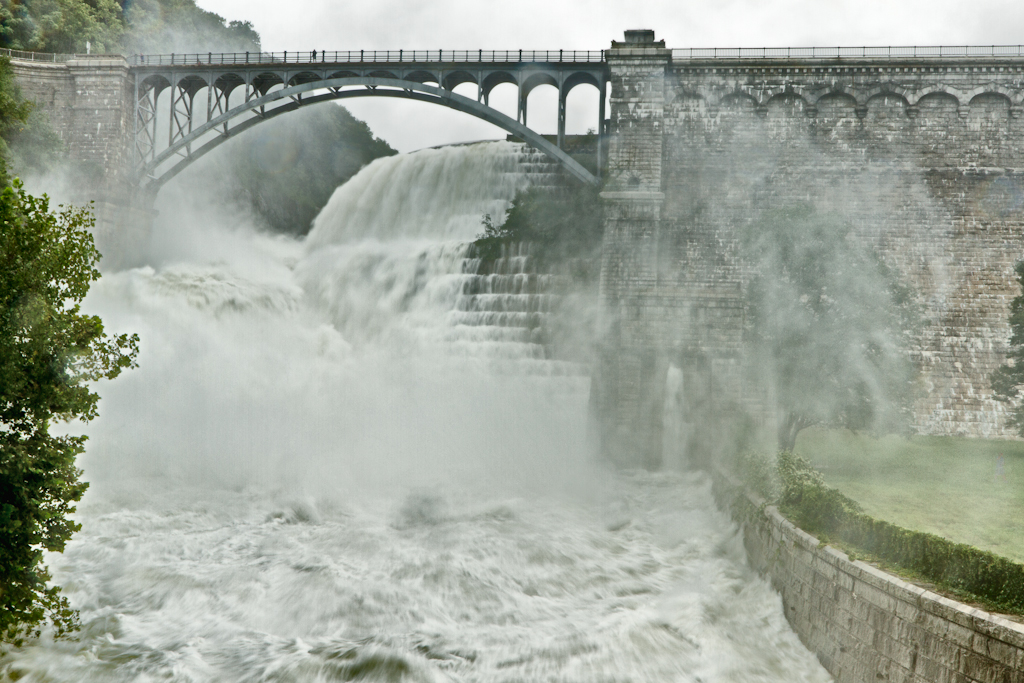
Slow Shutter/Waterfall Tips with Rick Sammon

New Croton Dam, NY
I am in New York this weekend with Rick Sammon.  Hurricane/Tropical Storm Irene just passed through the area.  My discussion in NYC was cancelled so we spent the day shooting around Croton-on-Hudson. 

We recorded a quick video discussing the top slow shutter speed and waterfall photography tips.  Rick and I, along with Juan Pons and Jennifer Wu, did a battle of the sunset photo tips last year at the California Photo Festival (2011 California Photo Fest) so we thought we would do a smaller version.


The top tips on the video, and one or two more, were:

1.  Use a tripod for stability.  When shooting slow a tripod allows you to keep everything solid except for the moving water.

2.  Use your cable release or camera's timer.

3.  Bring a neutral density filter or polarizers.

4.  Use live view.

A small "stream" that had popped up as a result of Irene.

5.  Reference live view's magnification frame to act as an expanded spot meter for perfect exposure.  I normally place the frame over the brightest area of the water I am trying to blur.  This area is normally (but not always) the shot's highlight and drives the overall exposure.

6.  After the shot reference your histogram to make sure the exposure is tight.

7.  Target half a second as your shutter speed.  As water speed changes you may need more or less.

8.  Keep a lens cloth and absorbent cloth nearby to wipe your lens and LCD.

9.  Maintain your SA (situational awareness,) always look behind you to make sure you are not missing a great shot.

Those were just a few we thought of on the spot in beautiful Croton-on-Hudson, NY.

 Same as above but with "enhancement." Took the image to Silver Efex and then blended the result using the Luminosity blend mode in Photoshop.

Check out a bunch of cool tips at Rick Sammon's blog here.

Fiat Lux and see you at the California Photo Festival!

Monday, August 22, 2011

The California Photo Festival- Don't miss the biggest photography event on the Central Coast!

Get your pass now to the 2nd annual California Photo Festival, October 12-16, 2011!


This year will be better than ever with 17 world class instructors, awesome hands-on learning, and the beauty of the Central Coast.

Our incredible line-up of instructors includes Rick Sammon, Hanson Fong, Rob Sheppard, Jennifer Wu,  David H. Wells and Hal Schmitt. Click here to see the full line-up of instructors.

With 170+ events during the week we have something for every level of photographer, from shooting horses on the beach at sunset to mastering indoor lighting techniques. Click here to see the full schedule of events!

Get your pass before August 30th and pay only $449 for all 5 days of the festival with our Early Bird discount. Use discount code "earlybird2011" to take advantage of this killer deal.

Visit www.CaliforniaPhotoFest.com or call the office 805-528-7385 for more details.


Fiat Lux!

Thursday, July 21, 2011

Set Specific Goals: A Tip from Rick Sammon

In photography (as well as in life, of course), it's very important to set goals. If you don't set goals, how do you know where you are going?

Here is an example of what I mean.

While teaching a private workshop in Mongolia, the student and I had the opportunity to get the shot that every horse photographer wants to get: a shot of the horse with all the hooves off the ground.

To get the shot, I told the student that we had to (and you can use these tips when photographing fast-moving subjects):

1) Set our Canon 5D cameras to the AI Servo focus mode - which tracks a moving subject right up until the moment of exposure.

2) Choose the rapid frame advance mode.

3) Compose the scene (using our Canon 100-400mm IS lenses) with lots of space around the subject – so no important parts were cut off.

4) Choose a shooting position where the light was just right.

5) Carefully watch the background so that the subject was completely isolated.

6) Take several series of images to ensure at least one good shot.

7) Use a shutter speed of at least 1/000th of a second to freeze the action.

8) Shoot with both eyes open - so we could see if something was coming into the frame that would ruin our pictures.

9) Check all our camera settings (ISO, Image Quality, white balance, etc.) to get the best possible in-camera exposure.

• • •

Setting the specific goal beforehand, and going through the motions of taking the shot in our hotel rooms, we became comfortable with the process. When we got on site, we practiced the process again and again - before the show.

All our practicing made getting the shot relatively easy - again, because we set a specific goal.


So . . . I told this story to my students while teaching a workshop at the Light Photographic Workshops in Los Osos, CA. The next day were were going to photograph horses running on the beach.

Guess what? They all set goals . . . and they all got the shot.

Set specific goals, and you'll have a better chance of getting the shots you envision in your mind's eye.

Explore the light,
Rick

Rick Sammon
www.RickSammon.info

Don't miss seeing Rick Sammon and 4 more Canon Explorers of Light at this year's California Photo Festival.
Early bird pricing ends August 30th! Register today at www.CaliforniaPhotoFest.com 

Tuesday, June 7, 2011

With Friends Like These...


Never a dull moment when your friends are Photoshop experts!

Although I do thank Rick Sammon for showing everyone how angelic I really am.

Would love to hear comments on a good caption for this shot.

Fiat Lux!

Monday, May 16, 2011

Do No Harm and Leave No Trace

© Rick Sammon

We as photographers are extremely fortunate to experience, tour, and capture many unique and interesting places around the world.  There are myriad benefits to both photographer and the local area/environment associated with our travels and shoots.  On the flip side, we must be cognizant of any damage we could do to the location.  In and of itself, photography is not a destructive process; we are normally not going to harm anyone or anything with the depression of our shutter release.  With that said, we know there is more to the process of making a great image.  We must consider how to structure our visits and use techniques and habit patterns that do no harm and leave little to no trace of our presence.

 © Lawrence Coleman

 As with all photography, it pays to research our subject. This is not just the subject itself, but also the environment in which the subject is found, the habits, patterns, rituals, etc. With full knowledge we are able to capture more effectively and make a compelling image while at the same time minimizing impact. If we consider the possible consequences of our visit we will be forced to look at things such as destruction or damage to native species, unkowing introduction of non-native species, pack it in/pack it out principles, waste management, how to appreciate, capture, and preserve vice removal and disturbance, and respect/standoff from wildlife.  This is just a quick list of things we should consider when entering any environment but especially those that might be sensitive. 

The largest impact we often have as photographers is based on our overland travel habits and what equipment we set up on location.  The simple act of walking to a desired shooting spot with gear and then setting down our bags, setting up our tripods, and remaining in one spot could cause problems.

© Diana Lewis Coleman

Of course, any impact is magnified when a group is involved.  Precautions must be taken to minimize the impact of more than one person.  For example, if there is a trail, all should stay on trail.  If there is not a trail, is it better to each take a different path to minimize repeated impact to the same area or does it make sense to limit our impact and follow in each others footprints.  There will probably never be one right answer but if we are educated and plan each trip properly we will, hopefully, choose the correct course of action.  Of course, sometimes the right answer is a place that is perfect for you might not be the best place to take your 50 person strong MeetUp or tour group.

We were fortunate to visit an amazing and sensitive area in south east Alaska a few weeks ago.  After a quick RHIB (rigid hull inflatable boat) ride we landed on a rolling ground moraine from a retreating glacier.  At first glance, it seemed to be just rocks.  Fortunately, our local guide prepared us with additional knowledge.  We understood the area was nesting habitat for migratory birds (made even more complicated as the nests looked like groups of rocks and the eggs look just like small rocks) and was also an emergent area (a place where local species were just taking hold.  Think of the initial reforesting process after a fire or after the deposit of volcanic ash.)  With this knowledge we soon saw that we needed to apply leave no trace principles in everything we did while ashore.

For those curious, Canon 1D Mk III, EF 800mm f/5.6L, and RRS PG-02

The Arctic Tern nests on the ground in some very sensitive locations.

The images in this post were captured by our group as they toured this amazing location.  It was an incredible experience to photograph this environment and I feel confident we did the best we could to minimize our impact. 

For more images of this awesome place check out Rick Sammon's blog at Chasing the Light with Light.

Fiat Lux!

Wednesday, February 16, 2011

Interview at DPE

Interview with Hal on The Digital Photo Experience website.

DPE Interview

Fiat Lux!

Friday, December 24, 2010

Guest Blogging on Rick Sammon's Site

Doing a little guest blogger duty over at Rick Sammon's blog.  Check out the link below.

Rick Sammon's Blog

Fiat Lux!

Thursday, June 11, 2009

Canon Explorer of Light Jennifer Wu!


We just confirmed Jennifer Wu's workshop coming up this September 25-27. Jennifer has been recently accepted as a Canon Explorer of Light! She specializes in unusual techniques in Landscape photography and has been teaching all over the world. She teams up with long time Canon gear representative Jim Rose. Jim has been a big supporter of both Jennifer Wu and a long time friend of George Lepp.

Check out their workshop page here for more information. http://www.leppphoto.com/Canon_Field_Photography_Workshop.html

This is going to be such a great class!


For those of you who haven't seen our summer schedule it is filling up fast so get these masters while you can in one of the most beautiful places on earth!
Rick Sammon, Hanson Fong and Hal Schmitt...none are to be missed!